Guides
UGC creator production quality: first principles
UGC production quality is decided by camera, light, sound, framing, edit and honesty, not by gear price. Here is what each craft element changes.
What to take away
- Quality is set by five things a viewer can namefocus, exposure, audio, framing and edit rhythm. Gear price sits far down the list.
- A phone on a tripod at chest height with a window behind the camera beats a cinema body held in one hand.
- Audio fails more often than video. A lavalier or a shotgun mic within a meter of the mouth fixes most of it.
- Every paid or gifted post needs a clear disclosure the viewer sees without tapping 'more'. The FTC endorsement guides set that bar.
- Fix one variable per shoot. Change light, then mic, then framing, and keep the takes that show the difference.
- Named starting pointsiPhone 15 or Pixel 8 for 4K, Rode Wireless GO II or DJI Mic 2 for audio, Aputure Amaran 100d or window light, CapCut or DaVinci Resolve for the edit.
UGC creator production quality is not a budget line. It is whether a viewer believes the person on screen, understands the product, and keeps watching past three seconds. Camera, light, sound, framing and edit decide that. Brand budget decides almost none of it.
This guide covers the shoot itself. For the business side, see best markets for a UGC creator business.
The six variables that decide how a UGC video looks
Camera and sensor. A recent phone shoots 4K at 24 or 30 frames per second, which is enough for every major platform. What matters is manual control: lock exposure and white balance so the shot does not drift mid-sentence.
The iPhone 15 records 4K at 24, 25 or 30 fps. The Google Pixel 8 and Samsung Galaxy S24 line offer 4K at 30 fps or higher. Blackmagic Camera for iOS is free and adds manual shutter, ISO and white balance.
A used Sony ZV-1 typically runs $400 to $700 and adds a zoom lens and cleaner audio input.
Light. One soft source at 45 degrees to the face, plus a bounce card or white wall on the other side, reads as 'shot in a room' rather than 'shot under a ceiling'. Window light is free and usually best. Avoid overhead-only light, which drops shadows into eye sockets.
The Aputure Amaran 100d is a 100W LED with a Bowens mount, often listed near $200. A Godox SL60W usually sells under $150. Neewer 660 LED panels often run $70 to $120. A white foam board from an art store costs a few dollars and fills the shadow side.
Audio. Room tone, echo and handling noise are what make a clip feel amateur. A wired lavalier costs less than a lens filter and removes most of it. Record 20 seconds of silence in each room; editors use it to fill gaps.
The Rode SmartLav+ lists around $80. The Rode Wireless GO II and DJI Mic 2 kits typically run $200 to $350 and include transmitters with built-in mics. A Shure MV88+ or Sennheiser MKE 200 can cover desk shots and interviews.
Framing. Eye line one third down from the top of frame. Chest-up for talking segments, wider for demonstrations. Leave headroom for captions, which cover the lower third on most feeds.
Turn on the 3x3 grid in the iOS Camera app or Android Camera settings. For vertical video, shoot 9:16 and keep the product inside the middle 60 percent of frame. A phone tripod clamp costs $20 to $40 and removes hand shake.
Edit rhythm. Cut on the breath, not the sentence. First frame must show the product or the problem. Keep the hook under three seconds and total runtime under 45 for a single-product piece.
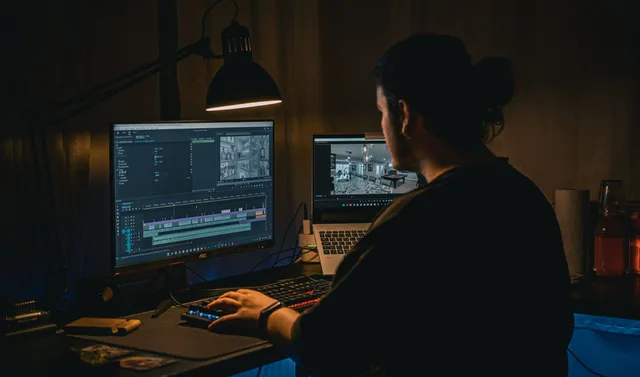
CapCut and Descript offer auto captions; DaVinci Resolve is free and handles color and audio repair. Paid tiers for these tools commonly fall between $8 and $30 per month, while Resolve Studio lists at $295 one time.
Authenticity. The format works because it looks like a person, not a commercial. Slight imperfection, natural speech and a real setting are features. Over-polished UGC reads as an ad and gets skipped.
Brands often ask for 'native' or 'raw' footage, but paid posts still fall under the same disclosure rules.
A shoot order that catches problems early
Run the same sequence every time so a failure is easy to trace.
UGC shoot order
- Brief reviewdeliverables, ratios, runtime, usage, disclosure
- Product and claim researchlabel, claims page, category rules
- Concept and scripthook, problem, demo, call to action
- Rights and disclosure review before filming
- Filminglock exposure, room tone, three hook takes
- Editcaptions, licensed music, no unlicensed logos
- Approval, revision, delivery and usage tracking
- Brief reviewconfirm deliverable count, aspect ratios, runtime, usage window and disclosure wording in writing.
- Product and claim research: read the label, the brand's own claims page and any regulated category rules. Do not repeat a claim the brand cannot support.
- Concept and scriptone hook, one problem, one demonstration, one call to action.
- Rights and disclosure review: check the endorsement guides and the platform's branded-content tools before filming, not after.
- Filminglock exposure, record room tone, capture three takes of the hook. Use a tripod clamp or tripod, and keep the mic within arm's reach of the mouth.
- Editcaptions burned in, music licensed, no unlicensed logos in frame. CapCut auto captions and DaVinci Resolve audio repair are common low-cost options.
- Approval and revisionsend a watermarked cut, log the requested changes, invoice the revision round if the brief allowed one.
- Delivery and usage tracking: note where and how long the brand may run it, then update the portfolio with the finished piece.
Where quality actually breaks
| Symptom | Usual cause | Fix |
|---|---|---|
| Viewer drops at two seconds | No product or problem in frame one | Reshoot the hook only |
| Sounds hollow | Bare room, mic across the room | Lavalier plus a rug or soft furnishing |
| Looks flat | Single overhead light | Add a window or a soft key at 45 degrees |
| Brand asks for a re-edit | Aspect ratio or runtime missed | Confirm specs in the brief before the shoot |
| Post gets flagged | Disclosure buried or missing | Put the disclosure in the first frame and the caption |
| Skin tone shifts mid-clip | Auto white balance | Lock white balance in Blackmagic Camera or the native camera app |
| Captions cover the product | No headroom in frame | Frame eye line one third down and keep product mid-frame |
| Music gets muted | Unlicensed track | Use the platform commercial library or a paid Artlist or Epidemic Sound license |
| Audio hums | Mic near a laptop fan or bare walls | Move to a Rode Wireless GO II or DJI Mic 2 and add soft furnishings |
Disclosure is part of production quality
A clip that hides a paid relationship is not high quality, however good it looks. The FTC endorsement guides require a clear and conspicuous disclosure of material connections.
Disclosure and safety checklist
- Disclosure clear and conspicuous, not buried
- Text overlay in the first frame
- Spoken disclosure at the start
- Visible without tapping to expand
- Find and fix on-set hazards per OSHA
- Attorney reviews contract, usage and exclusivity
The advertising FAQs for small business explain how that applies to testimonials and claims.
Put the disclosure where a viewer sees it without tapping to expand, and say it out loud in the video as well. A text overlay in the first frame and a spoken line at the start cover both.
On-set safety is a production variable too. The OSHA safety management guidance covers the general duty to find and fix hazards, which matters for shoots involving heights, vehicles, kitchens or power tools. For contract terms, usage windows and exclusivity, the FTC sets the disclosure standard and a licensed attorney reads the agreement.
Read next: UGC creator production tools: what the good ones share.
Read next: UGC creator production setup as practitioners see it.
Common questions
Does a better camera improve UGC quality?
Rarely. Most phones already shoot more resolution than the platforms serve. Light, microphone placement and framing change the result far more, and they cost less. An iPhone 15 or Pixel 8 with locked exposure beats a cinema camera on auto.
How long should a UGC video be?
Long enough to show the product working, short enough that nothing repeats. Single-product pieces usually land between 15 and 45 seconds. The first three seconds decide whether the rest is watched. Keep the hook under three seconds and the product in frame one.
What does the brand expect in a first draft?
The specs from the brief: aspect ratio, runtime, disclosure wording, and the product visible in frame one. Send a watermarked cut and list any revision the brief did not cover before you make it. A 9:16 vertical cut at 1080 by 1920 or 4K is the common ask.
Is a polished edit a problem?
It can be. UGC works because it looks like a person filmed it. Clean audio and steady framing help; heavy color grading, stock music and scripted delivery make it read as an advertisement. CapCut or Descript captions are enough for most brand briefs.